


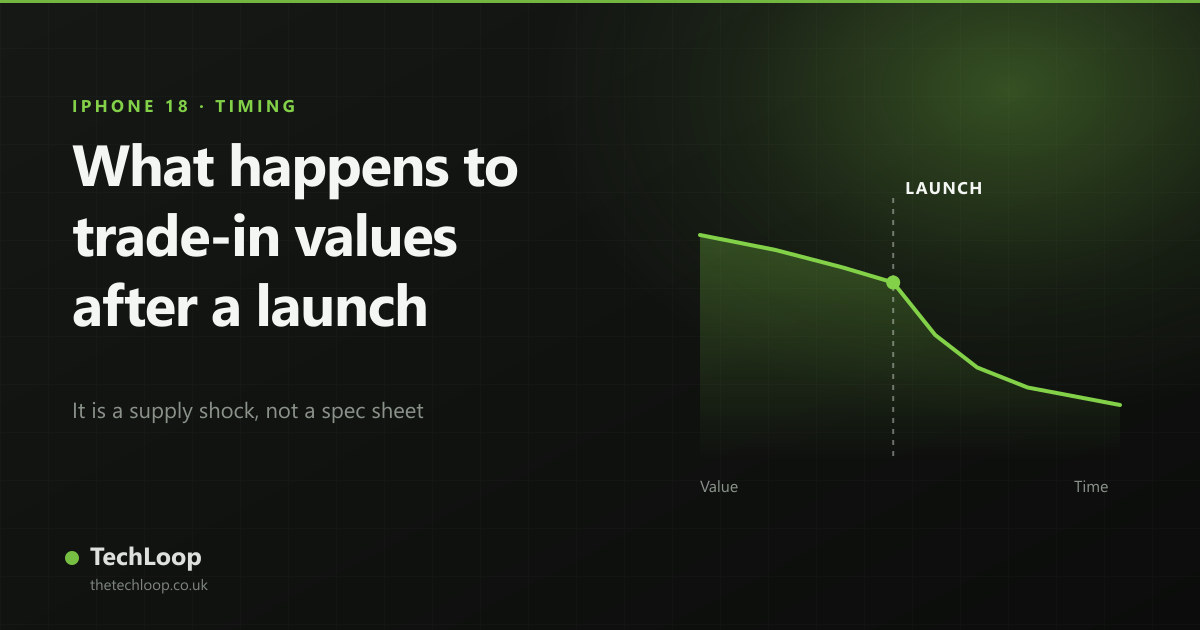
Ask when to sell an iPhone and you will get confident answers in both directions. The truthful version is less dramatic than either: launch timing matters a lot for some phones and barely at all for others, and the difference comes down to one thing — supply.
This is what actually happens to used iPhone prices around an Apple launch, why it happens, and how to use it.
The Mechanism: It Is a Supply Shock#
A new iPhone does not make your old one technically worse. On the day of the keynote your phone takes the same photos and lasts the same time on a charge as it did the day before.
What changes is the market around it.
Apple announces
Upgrade intent spikes overnight. People who had been vaguely considering a new phone commit to one. This year that was Wednesday 9 September 2026, when Apple announced the iPhone 18 Pro and Pro Max.
Pre-orders open
Buyers start clearing out their old handsets to fund the purchase. Trade-in submissions climb sharply. This year: Saturday 12 September, 1 p.m. UK time.
New phones arrive
The old handsets are now genuinely surplus. Supply peaks over the following four to six weeks. This year the phones go on sale on Friday 18 September.
Buyers get selective
With plenty of stock to choose from, recyclers and private buyers can hold out for clean, complete, well-described devices. Marginal phones get marginal offers.
The market re-levels
Supply normalises, prices settle at a new baseline, and the slower ongoing decline resumes.
That is the whole story. It is a supply shock with a predictable shape, and it repeats every year.
Where the Effect Actually Lands#
Not evenly. This is the part most advice gets wrong.
The models hit hardest are the ones a buyer would genuinely cross-shop against the new flagship. If someone is deciding between a new iPhone 18 Pro and a used iPhone 17 Pro, those two phones are in direct competition and the used one has to compete on price.
Nobody cross-shops an iPhone 18 Pro against an iPhone 11. Different buyer, different budget, different decision. So the iPhone 11's price barely notices the keynote.
What Our Own Price Ladder Shows#
We cannot show you the future, but we can show you the shape of iPhone depreciation as it stands today. These were our top pristine quotes at the time of writing (9 September 2026) — the ceiling for a flawless, unlocked handset at the highest storage tier.
| Generation | Pro Max | Pro | Standard |
|---|---|---|---|
| iPhone 17 | £905 | £741 | £495 |
| iPhone 16 | £711 | £611 | £476 |
| iPhone 15 | £511 | £441 | £356 |
| iPhone 13 | £331 | £291 | £231 |
| iPhone 12 | £226 | £196 | £156 |
| iPhone 11 | £155 | £141 | £108 |
Read down the Pro Max column and you can see the curve. The biggest steps are at the top — an iPhone 17 Pro Max to a 16 Pro Max is £194, and the 16 to the 15 another £200. By the time you reach the 12-to-11 step, the same generational gap is worth £71.
A live example of the ladder moving, from our own data: the top iPhone 17 Pro Max quote was £956 on 7 September 2026 and £905 on the morning of 8 September, after our overnight price update and before Apple's keynote. A £51 move in a day, on the phone with the most to lose, with nothing announced yet. The keynote is not the only thing that moves prices in launch week.
That is why "should I sell before the launch?" is really a question about which phone you own. On an iPhone 17 Pro Max, getting the timing right is worth more than most people's monthly phone bill. On an iPhone 11, it is worth a takeaway.
Percentages Lie, Pounds Do Not#
A 10% move sounds identical whichever phone you own. It is not:
| Model | Value | A 10% move costs |
|---|---|---|
| iPhone 17 Pro Max | £905 | £90 |
| iPhone 16 Pro | £611 | £61 |
| iPhone 14 | £261 | £26 |
| iPhone 11 | £108 | £11 |
If you own a current-generation Pro, timing is a real financial decision. If you own a five-year-old handset, the honest advice is to stop optimising and just sell it — the effort of waiting for a better window costs more than the window is worth.
The Thing That Actually Costs You More Than Timing#
Condition. By a distance.
Our smartphone grades apply roughly these multipliers: Pristine 100%, Good 85%, Fair 70%, Poor around 26%.
That Fair-to-Poor cliff is where real money disappears. On an iPhone 17 Pro Max:
| Grade | Roughly worth |
|---|---|
| Pristine | £905 |
| Good | £769 |
| Fair | £633 |
| Poor | £235 |
One drop onto a hard floor can move a phone from Fair to Poor and take close to £400 with it. No amount of clever launch timing recovers that.
How to Play It#
If you are definitely upgrading and can be without the phone: sell before the trade-in wave lands. You are selling into normal supply rather than a glut.
If you need the phone until your new one arrives: lock a quote now and post it on the day the replacement lands. A locked price is the whole point — it takes the launch-window risk off you.
If your phone is three or more generations old: stop timing it. Sell it whenever is convenient. The curve is shallow enough down there that waiting for the perfect week is not worth the thought.
If you are not upgrading at all: the drawer phones still count. They are depreciating on the same curve with none of the benefit of being used. Those have no reason to wait for anything.
If your upgrade arrives as a phone you do not need: a sealed, unopened iPhone 18 Pro from a carrier deal grades as Pristine and sells for cash. That is the flip side of the same launch — see selling your iPhone upgrade for cash. And if you are deciding whether to upgrade a 17 Pro Max at all, iPhone 18 Pro Max vs iPhone 17 Pro Max covers who should and who should hold.
TechLoop is an independent Swindon business. We are not affiliated with Apple.